What Is an EOB and How Do I Read It? Finally Explained.
Jul 28, 2026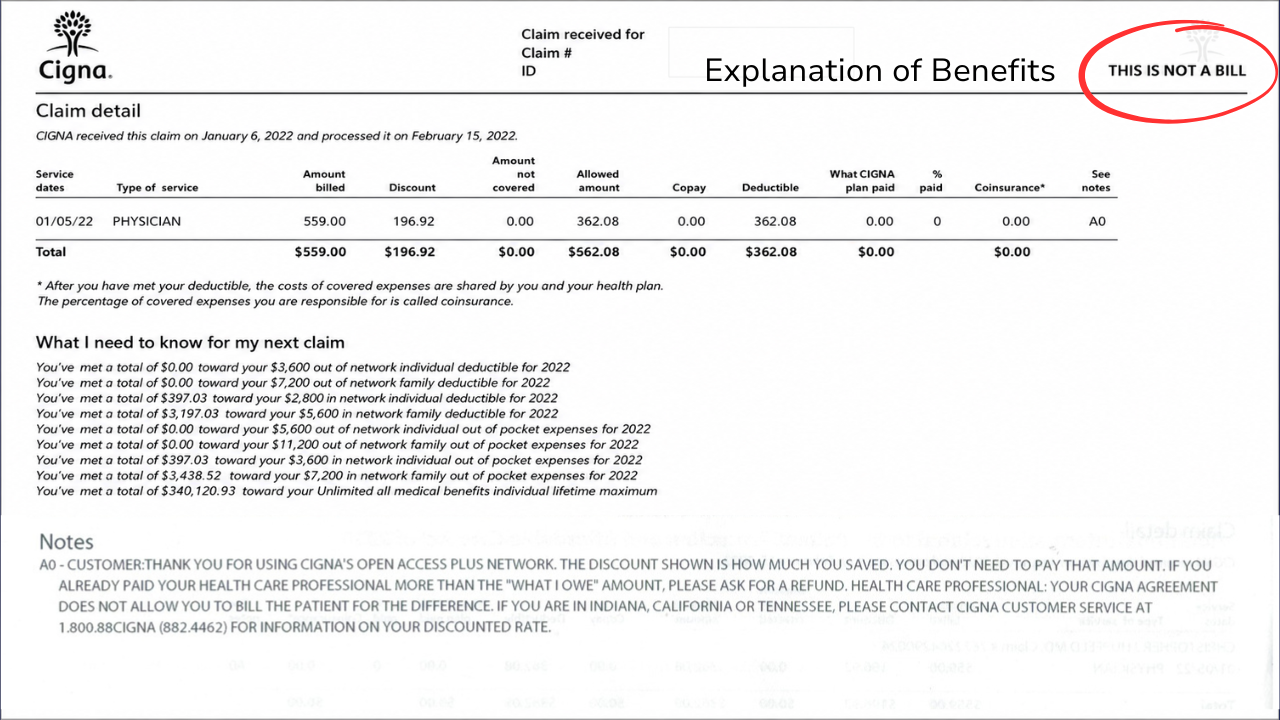
I had a client who said she stopped even opening the envelope that had the EOB in it because it was too overwhelming. Most people don't know what an EOB is or how to read it, but it is an extremely important document.
In this post, I will go over what an EOB is, how it isn't a bill, where you can find it, how to read it, why you get one even if you owe $0, what red flags to watch for, and how long to keep it.
What is an EOB and how do you read it?
An EOB is an Explanation of Benefits. It's the confusing document the insurance company sends after a visit or procedure. It explains exactly when you had the visit or procedure, your provider, what was billed, what was allowed, what was covered, what wasn't covered and why, and how much you owe. IT IS NOT A BILL!
On every EOB, it will say very clearly that it is not a bill. The main reason that an EOB isn't a bill is because it isn't coming from your provider. It is coming from your insurance company. An EOB is exactly what it says it is: the insurance company's explanation of your benefits, what was billed, what was allowed, what was paid by insurance, and what you may owe. I will walk you through each of these explanations just a little bit later.
Even if the EOB is 100% correct, it is still just the insurance company's side of paperwork. The insurance company doesn't send you a bill. Your provider does. Does that make it less important than the bill? No, because you have to check the insurance company's work, and later I will go over some red flags of when it's worth calling your insurance company. An EOB is the insurance side of billing, not the provider side. You do not pay anyone for your EOB. The only time you pay money is when your provider sends you a bill. And remember, as I said in my blog post, One Phone Call Before You Pay a Dime on Your Medical Bill, don't pay your medical bill until you have made sure it is correct and spoken to the billing department.
Can the numbers of an EOB change?
Yes, there are multiple reasons that an EOB doesn't necessarily equal what you will actually be billed.
- There can be a billing error.
- An EOB can be processed again, maybe because there was a billing error or maybe there was an issue if you have secondary insurance, when you have two insurance providers. One example of this is if you have traditional Medicare, Part A and Part B, and you purchase extra insurance.
- Multiple providers bill separately for the same visit. For a procedure I had, I got three separate EOBs for the same procedure. I got one about the physician who did the procedure, one about the radiology technician (imaging specialist), and one about the facility where I had the procedure. Your final share of the cost may be the total when each of these provider bills are added together.
- Charity Care or Financial Assistance can decrease what you owe. See One Phone Call Before You Pay a Dime on Your Medical Bill for information on Charity Care and Financial Assistance.
- A denial can still be appealed, so your share of the cost isn't set in stone. If part of the insurance claim was denied, the number on the EOB isn't locked in. You or your provider can file an appeal, which is the process of challenging your insurance company's decision on your insurance claim.
Now that you know why an EOB isn't a bill, there are a few things you need to know before you read an EOB. First and foremost, you must understand insurance coverage details, otherwise it is difficult to make sure that the EOB is accurate. Click here to read last week's post, HMO vs PPO, Premiums, Deductibles…Finally Explained, that explains everything you need to know about your insurance coverage. Second, you are capable of reading an EOB. It's just that no one ever taught you how. Lastly, if you know your insurance coverage details, and learn to read an EOB, you can catch billing errors before they cost you.
Where can I find my EOB?
There are two ways to get your EOB. You can get it by mail, or you can get it in your insurance company's portal (your online account). Sometimes, the insurance company automatically puts your EOB in the portal instead of mailing it. So, if you have a medical visit or procedure and you don't receive an EOB in the mail, be sure to check your insurance company portal before paying any bills. Some people prefer getting it in the mail and others prefer looking at it online. There is no “right” way to get your EOB.
How do I read my EOB?
Let's go through each column one by one.
Date of Service
This is the date that you had your provider visit or procedure. Make sure it's the actual date you received the service.
Type of Service
This is the person who you saw for the visit or who performed the procedure, or it may be the facility where you had the procedure. Make sure this is the person who actually performed the visit or procedure and the location where you received the service.
Amount Billed
This is the amount your provider billed the insurance company for your visit or procedure. This one is just for your information, and there is nothing for you to check.
Discount
This is the amount you save by using an in-network provider (a provider your insurance has a deal with). Your insurance company works out a lower price with these providers to save you money. With some network structures, like HMOs (Health Maintenance Organizations), you are only allowed to see providers that have a deal with your insurance company. Click here to see last week's blog post for more information on HMOs. This is also just for your information. There is nothing for you to check.
Amount Not Covered
This is the part of the amount billed that insurance says they don't have to pay. It is important to check to make sure this is correct, especially if you have met your out-of-pocket maximum, the maximum amount you pay for healthcare visits and procedures before insurance pays 100% for the rest of the year. For more information, click here to see last week's blog post for more information on out-of-pocket maximums.
Amount Allowed
This is the amount the insurance company says is the reasonable amount for the services provided. This could be an established amount that the provider has agreed to because of their contract with the insurance company. This one is just for your information, and there is nothing for you to check. From this amount, you will pay a percentage, if coinsurance applies. More on that below.
Copay
This is the flat rate you are required to pay before receiving services or a prescription and is based on your insurance plan. You may see a number here if it was something you paid upfront before receiving the services.
Deductible
This is the amount your insurance counts against your deductible, the set amount of money you have to pay yourself before insurance will pay a dime. What does this mean? If you haven't paid your deductible in full, you may see an amount under this column. It could be a portion of your deductible or your full deductible.
Amount Paid
This is how much your insurance company paid your provider or facility. On your EOB, the column may not be labeled “Amount Paid.” This may show up differently with different plans. Some examples are “CIGNA Plan liability” and “Amount Medicare Paid.”
% Paid
This is the part of the “Amount Billed” that your insurance paid.
Coinsurance
This is a percentage you will pay of the “Allowed Amount” for a covered service. Your insurance will cover the remaining percentage. Coinsurance only applies after you have met your deductible.
See Notes
This is where the insurance company will leave a code, for example “A0” or “499.” This is really important because this is where you will find out the “why” if something was or wasn't covered.
On some EOBs, underneath the columns we just discussed, they will put what you need to know for your next insurance claim. It will show you how much, in dollars, you have met of your deductible and how much you have met of your out-of-pocket maximum, the total amount you have to pay before insurance pays at 100% for the rest of the calendar year.
Why do you get an EOB, even if your portion of the cost is $0?
It is normal to panic when you receive a document with dollar amounts on it. You can remain calm because as I mentioned previously, an EOB is the explanation, from the insurance side, of what was billed, what they paid, and what you may owe. You deserve to see the breakdown, which reinforces the fact that you don't owe anything.
What red flags are there on an EOB that signal you should call your insurance company?
- There is a service listed that you don't remember receiving.
- You don't recognize the provider that's on the EOB.
- The date of service is wrong.
If you notice any of these issues, call your insurance company and let them know that there is potentially a problem.
How long should I keep an EOB?
The answer to this question varies depending on the source. Cigna, a large insurance company, recommends keeping your EOB for 1 year after the bill is paid in full. In my experience, that isn't long enough. Twice I have received bills from two years before. I didn't owe either one of them. If I didn't have the EOBs from two years before, it would have been difficult to challenge those charges. Another source recommends 3-5 years. Suzanne Kuhn, a professional organizer who focuses on medical records for patients with special needs, advises keeping EOBs for seven years if you use the documents to list your medical costs on your income tax return to lower what you owe.
In this blog post, I've walked you through what an EOB is, why it isn't a bill, how to read it, and what to watch for.
“I had called different agencies and organizations trying to get answers, but every conversation seemed to give me another piece of information without helping me understand the whole picture. Now I understand the process much better and, most importantly, I know what questions to ask, who I need to contact, and how to communicate about my mom’s situation. You helped me take something that felt enormous and confusing and break it into steps I could actually handle. We’re still working through the process, but now I feel like I have a plan instead of just reacting to the next problem.”
Clo Blanco, helping navigate care for her mother
Want to go further?
Decoding Healthcare opens October 31. It’s my four-step program that teaches you to understand your insurance coverage, verify every financial step, control communication, and navigate strategically.
Join the waitlist at healthcareuncomplicated.com/waitlist, and I’ll send you my free guide right away: 11 Questions To Ask Before You Pay Any Medical Bill. Waitlist members also get the early bird price.
Need help right now? I have three one-on-one spots open. Book a free 15-minute consult.
Coming Next Week: Your Insurance Said No. You Can Fight Back.
Definitions
EOB: Explanation of Benefits, a document from your insurance after a visit or procedure that tells you how much your provider billed insurance, how much your insurance company paid, and how much you may owe.
Billing Error: when the billing department makes a mistake, for example, using the wrong billing code or billing you for the same thing twice.
Billing Code: the numbers that correspond to the service or procedure you received that the billing department uses to bill the insurance company.
Secondary Insurance: when you have more than one insurance plan. In many situations, the secondary insurance will pay what the primary insurance doesn't pay.
Charity Care/Financial Assistance: when a billing department or hospital offers ways to pay less or pay nothing for your care.
Insurance Claim: the document that is generated when your provider's billing department submits a request for payment from your insurance company.
Appeal: the process by which you fight for a prescription or service to get it covered by insurance, after insurance has said, “No.”
In-Network Provider: a provider that has a contract with your insurance company.
HMO: Health Maintenance Organization, a type of insurance structure, where you must see a primary care provider before seeing a specialist, and you can only see providers that are in-network.
Amount Not Covered: the amount of money billed by your provider that insurance says they are not paying.
Out-of-Pocket Maximum: the maximum you have to pay for visits, prescriptions, or procedures before insurance pays 100% for the rest of the calendar year.
Deductible: the amount you must pay for visits, prescriptions, or procedures before insurance will pay a dime.
Amount Allowed: the amount insurance sets in their contract for how much they are willing to pay for a particular service.
Coinsurance: a percentage of the amount allowed for the visit or procedure after you have received the service. Your insurance pays the remaining percentage.
Copay: a flat rate that is paid upfront before you receive medical services.
Frequently Asked Questions
What is an EOB? An explanation of benefits (EOB) is the document sent by your insurance company that explains how much your provider billed, what insurance will and won't pay, and the amount you may be billed.
Is an EOB a bill? An EOB is NOT a bill. It is the financial explanation from the insurance perspective. A bill comes from your provider.
Do I have to pay anyone when I receive my EOB? No, you do not have to pay anyone when you receive your EOB.
Why does my EOB say “This is not a bill”? It says that it's not a bill because it is very easy to see a document that has the amount you may owe from a visit or procedure and think that it is a bill. The insurance company is letting you know that your EOB isn't a bill. It is just information.
Where can I find my EOB? You can find your EOB either online on your insurance portal (where you have an account with your insurance company), or it will be mailed to you.
Can the numbers on my EOB change? Yes, the numbers on your EOB can change. They can change for a number of reasons. A couple of examples: a billing error was caught or the insurance company didn't realize you had met your deductible.
Why did I get multiple EOBs for one visit? It is common to receive an EOB for the main provider of the procedure, for other providers that assisted in the procedure, and for the facility where the procedure took place.
Why do I get an EOB even when I owe $0? You get an EOB even when you owe $0 because you deserve an explanation of how the insurance company came to that conclusion.
What should I do if something on my EOB looks wrong? If something looks wrong on your EOB, call your insurance company.
How long should I keep my EOB? While recommendations vary, it's a safe bet to keep your EOB for 3-5 years, unless you have used your medical costs to lower the amount of taxes you owe. If that is the case, it is recommended to keep your EOBs for 7 years.
Sources
How Long Do I Need to Keep an Insurance EOB? | Pocketsense
Healthcare Uncomplicated provides general health system education only and does not offer medical, legal, or financial advice. Always consult a qualified professional for your specific situation.
Want to work with me? Book a free, 15-minute consult.